

Linda Sevilla Workplace Wellness and Training logo: a gold lotus above gentle mind waves inside a circleLinda SevillaWorkplace Wellness & Training

Featured workshop

Switching OffLeaving Work at Work

Ever finish your workday only to discover your mind hasn't clocked out?

This workshop looks at why leaving work behind isn't always as simple as closing a laptop, and gives each participant a personal way to mark the end of the day.

  • 60 minutes
  • Live on Zoom
  • Group hypnosis, optional

$850 CAD

For a group of up to 100 people. Larger group? Contact me.

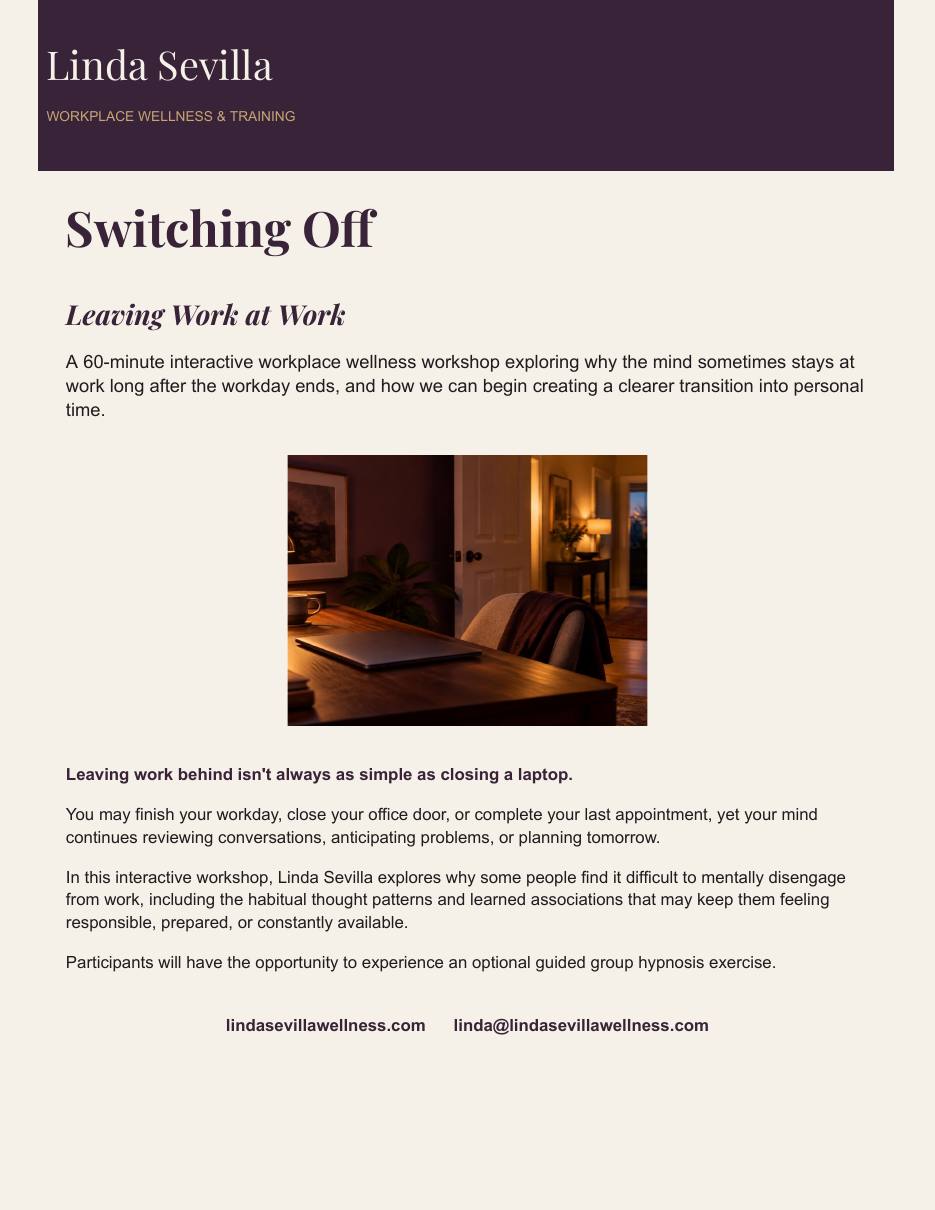
A closed laptop on a desk at dusk with a warmly lit hallway leading home

Sound familiar?

Physically, the day is over. Mentally, it keeps going.

Think about what happens when people finish work. They close their laptops, leave their offices, or finish their last appointment.

Physically, they've stopped working. Mentally, however, they may still be answering emails, reviewing conversations, anticipating problems, or planning tomorrow.

Dinner happens with half their attention. The evening walk becomes a meeting rehearsal. And by the time they finally relax, it's time to start again.

Understanding what's happening

The question underneath the behaviour

Occupational psychologists have a name for the ability to mentally disconnect from work during personal time: psychological detachment.

Sometimes we continue doing things that consciously make us uncomfortable because, at another level, we've learned to associate those behaviours with something important. Being prepared. Being responsible. Being valued. Being safe. Being good enough.

Persistent thinking, worrying, and remaining mentally alert can serve a perceived purpose. Perhaps someone has learned that staying on top of everything prevents mistakes. Perhaps being constantly available has become associated with being valuable. Perhaps they've become so accustomed to pressure that being inactive feels uncomfortable.

Some of these associations may have roots much earlier in life. A child praised mainly for achievement might connect productivity with approval. These are possibilities to consider, alongside workload, workplace expectations, personality, habits, and other circumstances. Nobody is told what their reason must be.

What someone experiences

What might be operating underneath

Constantly thinking about tomorrow's problems

“If I anticipate everything, I'll be prepared.”

Feeling uncomfortable when they're not productive

“My value comes from what I accomplish.”

Feeling guilty when they relax

“Resting means I'm lazy.”

Always going above and beyond

“If I work hard enough, I'll earn approval.”

Being unable to leave unfinished tasks alone

“If I don't stay on top of everything, something will go wrong.”

Answering work messages at all hours

“Being available makes me a good employee.”

Taking pride in constantly being busy

“Being busy means I'm important, successful, or needed.”

A surprisingly revealing question: “What would it mean about you if you weren't being productive?” For one person it means nothing; they're simply overwhelmed. For another it brings up “I'd feel lazy” or “I'd fall behind.” Participants reflect privately and never share their answers.

What participants will learn

Understanding, then something to practice.

01

A name for the experience

Understand psychological detachment and why the mind may keep working after the workday ends.

02

Insight into possible associations

Consider how beliefs about responsibility, preparedness, availability, or self-worth may keep attention tied to work.

03

A reason to step away

Recognize that rest and recovery can support concentration, energy, and perspective, and that being conscientious doesn't require being mentally at work every waking hour.

04

A personal transition ritual

Create a meaningful signal, through action, repetition, and imagery, that tells you the workday has ended.

05

A practice to continue

Leave with a simple self-hypnosis approach to rehearse and strengthen that transition at home.

What happens during the workshop

An hour that's experienced, not just heard.

Accessible education

Clear, engaging explanations of the patterns behind the experience, grounded in research and decades of clinical work.

Private reflection

Thoughtful questions to consider quietly. Nobody is asked to share personal answers.

Practical techniques

Tools participants can use the same evening and keep practicing on their own.

Optional group hypnosis

A guided experience participants can join or simply listen to. Taking part is always voluntary.

Discussion and application

Time for questions and for thinking about how the ideas apply to everyday working life.

Hypnosis is always voluntary. Participants remain aware and in control, can stop at any time, and are never required to disclose personal experiences, either during the session or afterward.

The group hypnosis experience

Creating your own transition signal

During the optional hypnosis portion, participants imagine themselves leaving work, choosing their own signal, and rehearsing that transition. The beauty of it is that the symbol is theirs.

No one is handed the same symbolic solution. Each person develops something personally meaningful, which is what makes it so well suited to a group.

  1. 1

    Broader suggestions

    The subconscious doesn't need to keep you engaged with work every waking moment to help you succeed. There is value in stepping away, replenishing energy, enjoying relationships, and resting.

  2. 2

    Choosing a signal

    Some people imagine taking off the day's responsibilities along with their work clothes. Others picture the day's worries washing away in the shower. Someone else might use a particular song.

  3. 3

    Rehearsing the transition

    Participants mentally rehearse using their signal, so that with repetition it can become a familiar cue for shifting attention toward the rest of their lives.

Who is this workshop for?

Teams who will recognize themselves here

  • Professional services firms where long hours and high expectations are the norm
  • Law and accounting teams who carry demanding files home in their heads
  • Managers and team leads who feel responsible for everything going right
  • Remote and hybrid teams where work and home share the same room
  • Healthcare and client-facing staff recovering from emotionally demanding days
  • Organizations looking for a lunch-and-learn on stress recovery and work-life boundaries

Research supporting the topic

What the research says about the subject

38,124 employees

A Meta-Analysis on Antecedents and Outcomes of Detachment from Work

Wendsche & Lohmann-Haislah, 2017

Across 86 publications, employees who were better able to mentally disconnect from work tended to report less exhaustion, better sleep, and greater wellbeing. It also found positive associations with task performance, though that shouldn't be read as proof that switching off automatically improves productivity.

Read the published research
30 intervention studies

Interventions for improving psychological detachment from work: A meta-analysis

Karabinski, Haun, Nübold, Wendsche & Wegge, 2021

Across 30 studies with 3,725 participants, interventions designed to improve psychological detachment had a statistically significant positive effect, averaging a small-to-moderate improvement. Longer and more intensive interventions generally produced stronger effects.

Read the published research

159 studies reviewed

Facilitating detachment from work: A systematic review, evidence-based recommendations, and guide for future research

Agolli & Holtz, 2023

Reviewed 159 empirical studies on what helps or hinders employees in mentally disengaging from work, including job demands, technology, and blurred boundaries between work and personal life, and offers practical recommendations for organizations.

Read the published research

393 participants

Mindfulness and cognitive-behavioral strategies for psychological detachment: Comparing effectiveness and mechanisms of change

Reis, Hart, Krautter, Prestele, Lehr & Friese, 2024

In a randomized trial, both a mindfulness-based program and a program teaching cognitive-behavioural strategies substantially increased psychological detachment from work, and to a similar degree.

Read the published research

Nearly 100,000 participants

Recovery Experiences for Work and Health Outcomes: A Meta-Analysis and Recovery-Engagement-Exhaustion Model

Headrick, Newman, Park & Liang, 2023

Across 316 independent samples, psychological detachment was associated with reduced negative outcomes such as exhaustion and work-family conflict, but the analysis did not find a clear benefit for job performance.

Read the published research

An important distinction

This research shows that difficulty disconnecting from work is well studied and that some interventions can help. Linda's transition ritual, developed through group hypnosis, is her own approach. It has not been tested in these studies, and we don't claim it produces the same outcomes.

Want to go further?

Want to Explore This Subject More Deeply?

The one-hour workshop introduces important concepts and practical techniques. An extended six-week program allows participants to explore patterns more thoroughly, develop additional tools, and reinforce learning over time.

An extended Switching Off program might look something like this. It's an illustrative outline, adapted to each organization, not a fixed offering.

  1. Week 1

    Understanding automatic patterns

    Why the mind may continue working after the workday ends.

  2. Week 2

    The need to stay prepared

    Exploring worry, anticipation, and the belief that constant thinking prevents problems.

  3. Week 3

    Productivity and self-worth

    Examining associations between achievement, approval, and personal value.

  4. Week 4

    Responsibility and boundaries

    Exploring the beliefs that make it difficult to say no, delegate, or stop being available.

  5. Week 5

    Learning to disengage

    Developing new associations around rest, recovery, and enjoying personal time.

  6. Week 6

    Making changes sustainable

    Reinforcing new responses, practicing self-hypnosis, and creating individual plans for continuing.

Front page of the Switching Off workplace wellness workshop PDF

Take it with you

Switching Off: The Full Workshop Details

A six-page PDF covering what participants will learn, how the 60 minutes are spent, the optional group hypnosis experience, Linda's professional background, and the research behind the topic.

  • What participants will learn, and the techniques they leave with
  • How the 60 minutes are structured, including the optional group hypnosis
  • Who the workshop suits, Linda's background, and the research behind the topic

Looking for something different?

Not Quite What Your Organization Needs?

I also design customized workshops and extended programs tailored to your organization's particular needs, industry, and workforce.

This workshop offers insight and a starting point. It is educational, not individualized therapy, and it doesn't suggest employees alone are responsible for boundaries that workplace practices make difficult.

Begin the conversation

Bring Switching Off to your team.

Share a little about your organization and timing, and we'll talk about whether this workshop is the right fit. Inquiries are an invitation to discuss possibilities, never a commitment.